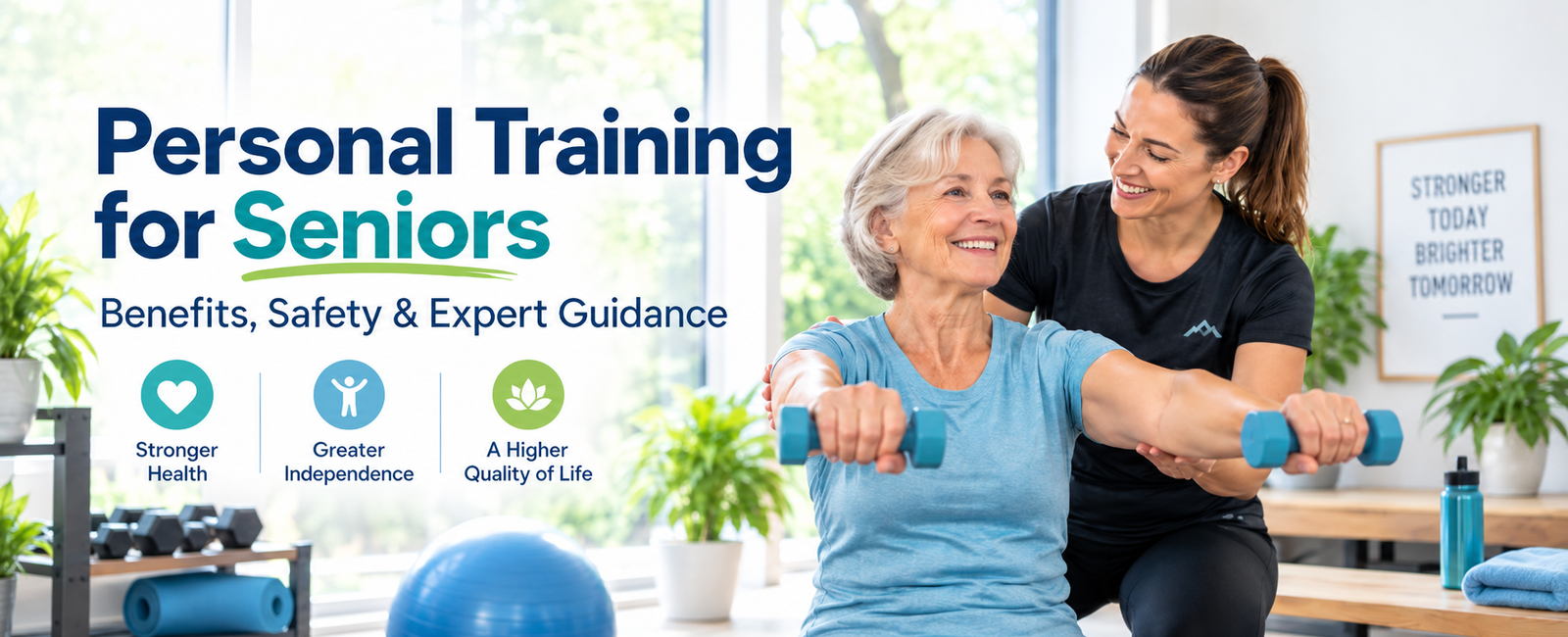
Personal training for seniors helps older adults stay active with exercises that match current ability and goals. Staying active becomes increasingly important as we age, but the way we exercise may need to change. Workouts that felt comfortable years ago may no longer suit current mobility, balance, strength, or recovery levels. A well-designed senior fitness program is not simply a lighter version of a standard workout. It should consider current fitness ability, movement limitations, personal goals, previous injuries, confidence levels, and overall lifestyle. With the right guidance, older adults can continue building strength, improving mobility, supporting balance, and maintaining the independence needed for everyday life.
Why Personal Training Matters for Seniors
Aging commonly brings changes in muscle strength, flexibility, coordination, balance, and recovery. These changes can make some older adults hesitant to exercise, especially if they are concerned about falling, joint discomfort, or performing movements incorrectly. Personal training for seniors provides a more structured approach because instead of following a generic exercise routine, seniors can work through exercises that match their current capabilities and gradually progress as their confidence and fitness improve. A trainer can also monitor technique, modify exercises when necessary, and make workouts more manageable for people who are returning to exercise after a long break.
Benefits of Personal Training for Seniors
Improved Strength for Everyday Activities
Strength training becomes especially valuable later in life because everyday activities depend heavily on muscle strength. Standing up from a chair, carrying groceries, climbing stairs, lifting household items, and maintaining good posture all require adequate strength. Personal training for seniors may include exercises using body weight, resistance bands, light weights, or other forms of resistance. The goal is not necessarily to lift heavy weights but to gradually build functional strength that supports everyday movement and makes daily tasks easier to manage.
Better Balance and Coordination
Balance can become more challenging with age, and losing confidence in balance may cause some people to move less than they otherwise would. Personal training for seniors can include controlled balance exercises, lower-body strengthening, coordination drills, and movements that challenge stability at an appropriate level. Examples might include supported single-leg exercises, heel-to-toe walking, controlled step movements, or sit-to-stand exercises. Improving balance and lower-body strength can help older adults move with greater confidence during everyday activities.
Increased Mobility and Flexibility
Stiffness can make simple activities such as bending, reaching, walking, or turning more difficult. Personal training for seniors may therefore include mobility exercises for areas such as the hips, shoulders, ankles, and upper back. Improving mobility can help make movement feel easier while supporting better exercise technique, and flexibility work can also be incorporated gradually instead of forcing uncomfortable stretches. The focus should always be on comfortable, controlled movement rather than pushing the body beyond a suitable range.
Greater Independence
One of the biggest benefits of personal training for seniors is the ability to continue doing everyday activities independently. Strength, balance, mobility, and cardiovascular fitness all contribute to functional independence. For example, stronger legs may make it easier to stand from a chair, while better balance can improve confidence when walking outside. Improved upper-body strength may also make household tasks easier. The purpose of senior fitness should therefore extend beyond completing workouts and help support the activities that matter most in daily life.
Cardiovascular Fitness and Endurance
Personal training for seniors does not have to focus entirely on strength exercises because cardiovascular activity also plays an important role. Depending on individual ability, cardio may include brisk walking, stationary cycling, swimming, low-impact circuits, or similar activities. Improved cardiovascular endurance can make everyday activities feel less tiring and help seniors remain active for longer periods. A balanced fitness routine for older adults can include aerobic activity, muscle-strengthening exercises, and balance-focused movements, while the appropriate amount and intensity should always depend on the person’s current ability and health situation. The CDC’s activity guidance for older adults also recommends combining aerobic, strength, and balance activities.
Support for Healthy Weight Management
Body composition and metabolism can change with age, while reduced daily activity can make healthy weight management more difficult. A balanced senior fitness routine that combines resistance training, cardiovascular activity, and regular movement can support overall weight management. Rather than focusing only on calories burned during a workout, senior fitness should emphasize maintaining muscle, staying active, improving mobility, and creating sustainable exercise habits that can be followed consistently over time.
Mental and Emotional Benefits
Exercise benefits more than physical fitness because regular activity can provide structure to the week, create a sense of accomplishment, and help people feel more confident about what their bodies can do. Progress does not always need to mean lifting heavier weights. Improvements such as walking more comfortably, completing more repetitions, standing with better balance, or feeling less tired during daily activities can all be meaningful achievements. Personal training for seniors can also provide encouragement and accountability, which may make it easier to remain consistent with a regular fitness routine.
Personalization Makes Senior Training Different
There is no single workout plan that is suitable for every older adult. Two people of the same age may have completely different fitness levels, with one person already walking several miles regularly while another may be returning to activity after years of inactivity. Personal training for seniors can account for current strength and mobility, balance and coordination, exercise experience, previous injuries, joint limitations, current activity level, personal fitness goals, and preferred training environment. Exercises can then be progressed gradually rather than expecting the person to immediately follow a demanding routine.
- Current strength and mobility
- Balance and coordination
- Exercise experience
- Previous injuries
- Joint limitations
- Current activity level
- Personal fitness goals
- Preferred training environment
How Personal Trainers Make Senior Workouts Safer
Safety should be one of the main priorities in personal training for seniors. A trainer can help by selecting appropriate exercises, explaining correct technique, adjusting resistance, controlling workout intensity, and modifying movements that cause discomfort. For example, a traditional squat may be replaced with a supported sit-to-stand exercise, floor exercises may be adapted if getting down to the floor is uncomfortable, and balance exercises may initially be performed near stable support. These modifications allow seniors to work toward the same general fitness goals without unnecessarily increasing difficulty or discomfort.
Start With Controlled, Gradual Progress
Progress does not need to happen quickly to be effective. Someone beginning personal training for seniors may initially focus on basic movements such as walking, chair-based exercises, supported balance work, and simple resistance exercises. As strength and confidence improve, workouts can gradually become more challenging. This approach helps create sustainable progress while allowing the body time to adapt and reducing the temptation to do too much too soon.
What Can a Senior Personal Training Session Include?
A session will vary depending on individual needs, but a balanced workout may include several components that work together to improve overall movement and fitness. The exact format should depend on the person’s goals, mobility, exercise experience, and current ability.
Warm-Up
The session may begin with gentle movement to prepare the joints and muscles. Walking, shoulder movements, ankle mobility, or light dynamic exercises may be used to increase circulation and help the body transition comfortably into the workout.
Strength Training
Exercises may focus on major muscle groups using resistance bands, dumbbells, machines, or body weight. Resistance should be appropriate for the individual and increased gradually as strength and confidence improve.
Balance Training
Controlled movements may be added to challenge stability and coordination. These exercises can begin with additional support and gradually become more challenging as balance improves.
Mobility Work
Exercises may focus on improving comfortable movement through the hips, shoulders, ankles, and spine. Better mobility can support everyday activities and help other exercises feel more natural and controlled.
Cardiovascular Exercise
Walking, cycling, or low-impact circuits may be included depending on fitness level. Cardio can be adjusted in pace and duration so that it remains suitable for the individual’s endurance and recovery ability.
Cool-Down
The workout may finish with slower movement, breathing exercises, or comfortable stretching. A gradual cool-down can help the body transition out of the workout and give the person a chance to finish the session feeling relaxed rather than exhausted.
Training With Joint Pain or Limited Mobility
Having limited mobility does not automatically mean exercise should be avoided. In personal training for seniors, many exercises can be modified to reduce impact or make movements easier to control. Someone with difficulty standing for long periods, for example, may begin with chair-supported exercises, while a person with limited shoulder mobility may use a smaller comfortable range of motion rather than forcing the joint. For people with chronic medical conditions, disabilities, significant pain, or recent surgery, appropriate exercise should be discussed with a healthcare professional before beginning or substantially changing a fitness routine. The National Institute on Aging’s exercise resources explain the potential benefits of physical activity for older adults.
How Often Should Seniors Exercise?
The frequency of personal training for seniors depends on fitness level, goals, recovery ability, and health considerations. Some seniors may start with shorter sessions a few times per week, while others may comfortably complete more frequent activity. Rather than concentrating only on the number of training sessions, it is useful to build a weekly routine that includes movement, strength work, cardiovascular activity, and balance exercises. Consistency is usually more valuable than occasional intense workouts, especially when the goal is long-term strength, mobility, and independence.
How to Choose a Personal Trainer for Seniors
When choosing a personal trainer for seniors, look for someone who is comfortable adapting exercises and working with different levels of mobility and fitness. A good trainer should take time to understand the person’s goals and limitations before creating the program and should be willing to explain why exercises are being used rather than simply asking the client to complete a predetermined routine. Clear communication is particularly important, and seniors should feel comfortable mentioning discomfort, uncertainty, fatigue, or difficulty with a movement so that the exercise can be adjusted when necessary.
Personal Training for Seniors in San Francisco
For older adults looking for personal training for seniors in San Francisco, workouts can be adapted to different environments and lifestyles. Some people prefer training at home because it eliminates travel and allows them to exercise in a familiar environment, while others may enjoy outdoor workouts, apartment fitness spaces, or other convenient locations. Run Fit Well focuses on personalized fitness training designed around the individual’s goals, movement ability, and current fitness level. Senior training can focus on practical goals such as improving strength, maintaining mobility, developing better balance, increasing endurance, and feeling more confident during everyday activities.
When Should You Consider Senior Personal Training?
Senior personal training may be worth considering if you want to become more active but are unsure where to begin, feel your strength has decreased, want to improve balance, or find everyday movements more difficult than before. It can also be useful for people returning to fitness after a long break, those who prefer personalized guidance instead of group workouts, or anyone who wants exercise modifications based on their individual abilities.
- Want to become more active but are unsure where to begin
- Feel your strength has decreased
- Want to improve balance
- Find everyday movements more difficult than before
- Are returning to fitness after a long break
- Prefer personalized guidance instead of group workouts
- Want exercise modifications based on your abilities
- Need accountability to remain consistent
- Want to maintain an active and independent lifestyle
You do not need to already be fit before starting personal training. The program should begin at a level appropriate for you and progress gradually based on how your strength, balance, mobility, and confidence improve.
Final Thoughts
Personal training for seniors is about much more than completing exercises. A well-planned program can help older adults develop strength, improve balance, maintain mobility, build endurance, and feel more confident in everyday movement. The most effective approach is personalized, gradual, and sustainable, with exercises that match the individual’s current ability and progress only when they are ready. Whether your goal is to stay independent, return to regular exercise, improve mobility, or simply feel stronger during daily activities, structured fitness training can provide a practical path toward staying active as you age.
Frequently Asked Questions
Is personal training safe for seniors?
Yes, personal training for seniors can be appropriate when exercises are selected according to the individual’s fitness level, mobility, and health considerations. Exercises can be modified to make movements more comfortable and manageable, and progression should be gradual rather than rushed.
Can beginners start personal training later in life?
Yes. A senior does not need previous gym or exercise experience to begin. Training can start with simple movements and gradually progress as strength, coordination, and confidence improve over time.
Can seniors with limited mobility exercise?
Many exercises can be adapted for people with mobility limitations. Chair-based movements, resistance bands, supported balance exercises, and modified ranges of motion are some options that may be used depending on individual needs and comfort.
How often should seniors work with a personal trainer?
There is no single schedule that works for everyone. Frequency depends on goals, fitness level, recovery, and the amount of activity being completed outside personal training sessions. A trainer can help create a routine that is challenging enough to make progress without making recovery unnecessarily difficult.
What exercises are best for seniors?
A balanced senior fitness program often includes strength training, balance exercises, mobility work, and cardiovascular activity. The specific exercises should be selected according to the person’s abilities, goals, and any movement limitations that need to be considered.
Can personal training help seniors stay independent?
Strength, balance, mobility, and endurance are all important for everyday activities. Improving these areas can support a person’s ability to continue moving confidently and completing daily tasks independently.
Is home personal training suitable for older adults?
Yes. Home personal training for seniors can be particularly convenient for older adults who prefer a familiar environment or want to avoid travelling to a gym. Many strength, mobility, balance, and cardiovascular exercises can be completed with minimal equipment, making home-based training a practical option for many seniors.